Chemistry has a data problem
Today, there are only around 600 NADES systems documented, and nearly 70% of them rely on the same molecule: choline chloride. At the same time, science still lacks reliable ways to predict whether a eutectic system will form, or how its physicochemical properties will behave.
Written by
Federico Gomez, PhD

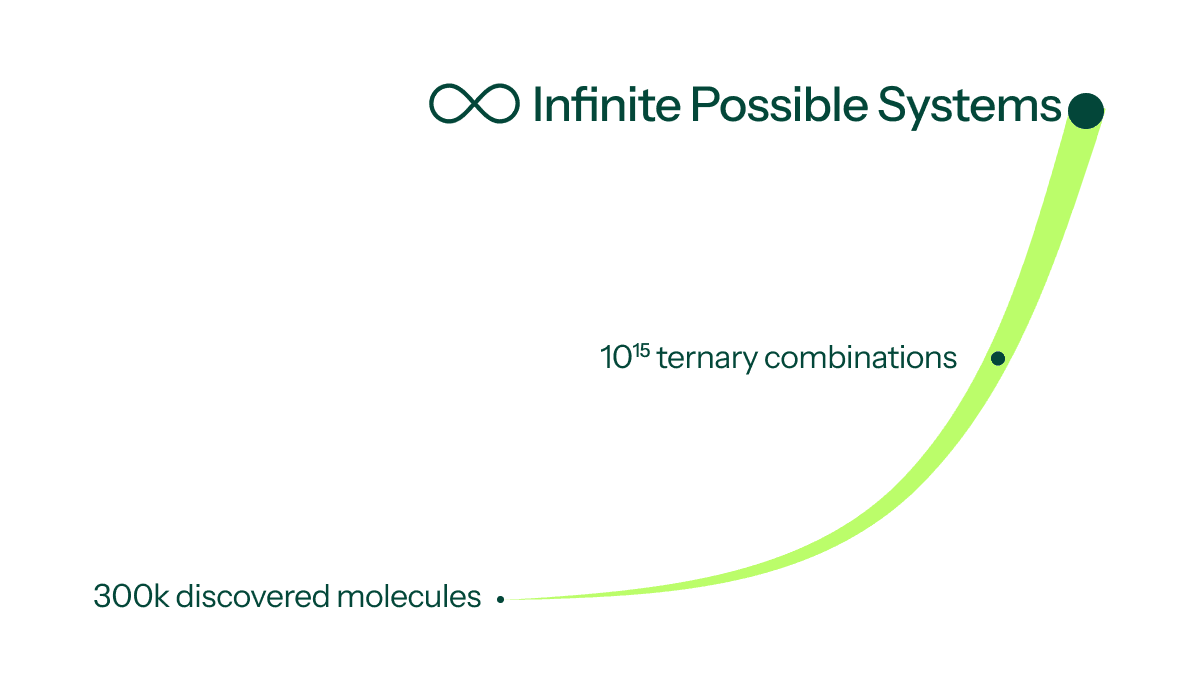
More than 300,000 natural molecules have already been identified worldwide, yet an estimated 90% remains undiscovered.
Our proprietary experimental database currently contains around 300 molecules.
With only those 300 molecules, and creating up to 10-component systems, we can generate 1018 possible combinations.
And when molar ratios are added, the number scales to 1026.
At that point, traditional trial-and-error chemistry becomes impossible.
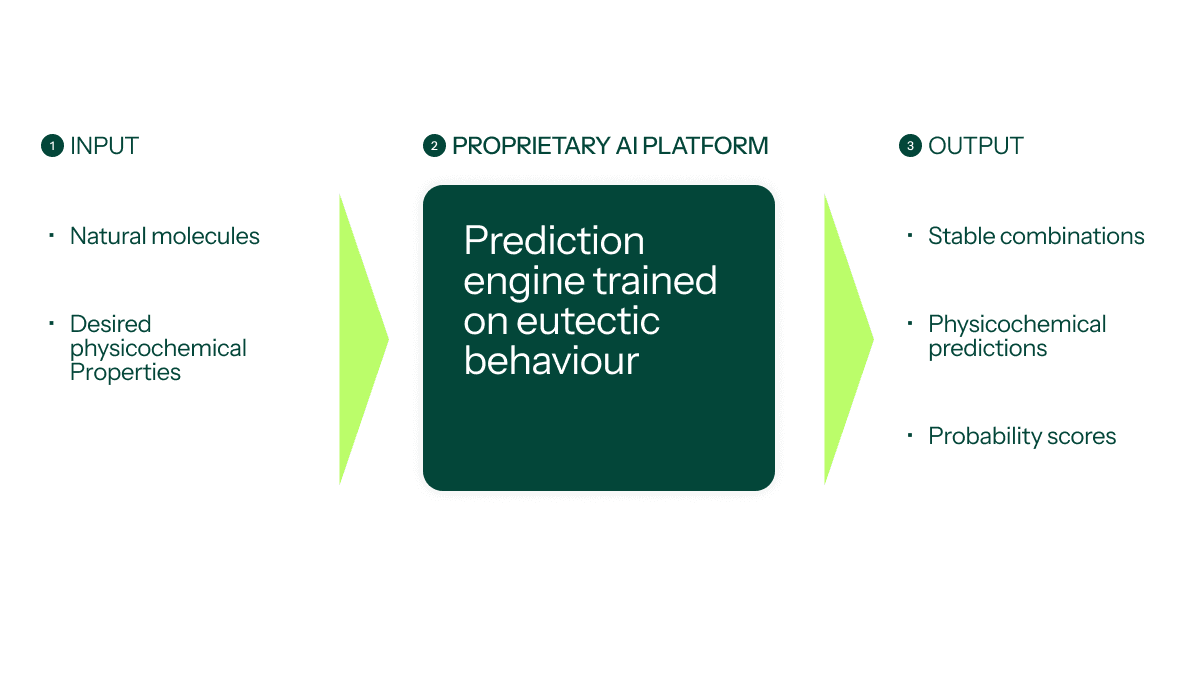
That bottleneck led us to build a proprietary artificial intelligence infrastructure designed specifically for eutectic systems, built on more than a decade of experimental research conducted by us.
Instead of screening thousands of combinations blindly in the lab, the platform helps narrow the search space dramatically.
But it doesn't simply suggest formulations. It estimates the probability of eutectic formation and helps identify which experimental paths are worth pursuing and which ones are not.
One of the most interesting parts is that researchers can literally chat to the system.
For example:
“Show combinations compatible with resveratrol.”
Or:
“Which molecular families are more likely to form NADES systems?”
Among the outputs it generates are heatmaps that reveal interaction patterns between molecular families such as organic acids, sugars, amino acids, polyols, phenols and terpenes. These visual maps help researchers identify areas of high and low probability across the eutectic design space.

Initially, we identified around 116 eutectic combinations.
Today, using the platform, that number has grown to +12,000 predicted and validated combinations.
Did you enjoy this article?
AI is becoming part of the infrastructure needed to explore chemistry. If you would like to know more, please write to us.