Dilution Is Not Deactivation: What Actually Survives When a NADES Meets Water
“How much can you dilute a NADES before it stops working?” This is the question we hear most often from people evaluating NADES for the first time. It's a reasonable question, and it deserves a precise answer.

Written by
Federico Gomez, PhD

Two different questions, often confused
There are really two separate things being asked here.
The first is a structural question: does the final product remain a classical, continuous eutectic phase?
At very high water content, not necessarily. Water competes for hydrogen bonding, and above a certain threshold, some systems reorganize into something closer to a structured aqueous solution.
The second is a functional question: does the NADES-derived system continue to deliver measurable performance after dilution?
Here the answer, across a growing body of published and proprietary evidence, is yes, provided the composition, active, endpoint and formulation are designed for it.
A NADES doesn't need to remain the majority phase of a formula to be worth using. It needs to change the behavior of the active, extract or biological interface it's paired with.
What actually happens as you add water
As a NADES is diluted, it moves through different states. But even at the extremes, the underlying interactions remain.
At moderate dilution, the structure and function hold. Structural studies have detected NADES components still interacting with each other even at 20% NADES in 80% water, meaning the molecular organization doesn't disappear. In a functional study, at 10% v/v, one system improved the detection signal of a test compound by roughly 380% compared to plain buffer.
Push to extreme dilution, and the pattern still holds. Independent research has recorded antimicrobial activity from certain NADES at concentrations below 0.01%, in media that are more than 99.99% water.
The most recent and strongest example comes from a 2025 study on a menthol-thymol NADES tested against a drug-resistant strain of Candida albicans: at around 0.02–0.04% concentration, it reduced fungal survival by nearly 99%, and in some cases eliminated it completely. That's a diluted eutectic system still acting on a living organism in a medium that's almost entirely water.

There's no need to remove it
In several published formulations, a NADES extract stayed in the final product and kept working:
In a 2024 study, NADES extracts of bilberry and green tea were added into sunscreen gels alongside conventional UV filters. They boosted SPF performance rather than diluting it away.
A Food Chemistry study using NADES to extract anthocyanins from blueberries increased their bioavailability by 140% compared to a conventional solvent extract, with the NADES still present in the final ingredient.
In both cases, the NADES wasn't a processing step to be removed afterward, it became part of what the product does.
A proprietary example: less active, more performance
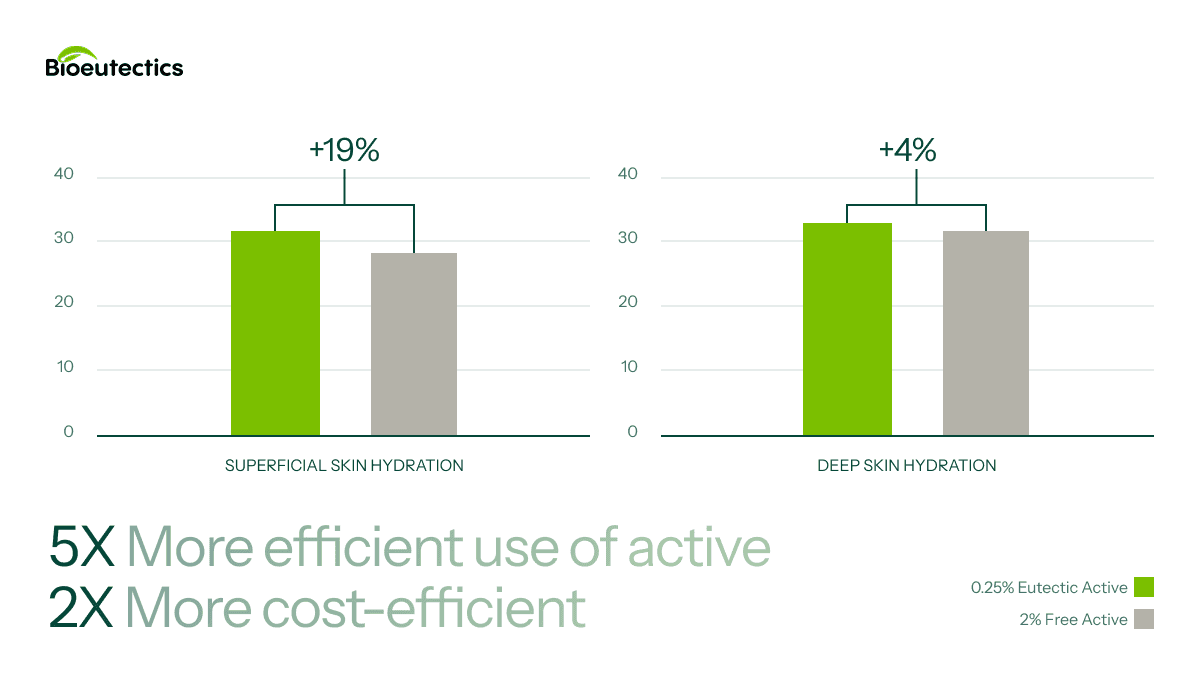
In one formulated aqueous serum, a eutectic HA system was incorporated at 5% w/w, bringing the final hyaluronic acid content in the product down to just 0.25%.
Compared against a conventional formulation using 2.0% free hyaluronic acid, eight times more active, the eutectic system delivered stronger hydration performance after three weeks: 68% improvement in superficial hydration versus 48% for the higher-load control, and 13% versus 9% at deeper skin layers.
Why this happens
There isn't a single mechanism behind dilution resilience. Different systems rely on different ones.
The active may remain associated with NADES components through hydrogen bonding or ionic interactions even as the surrounding phase becomes mostly water.
NADES can also keep sensitive or poorly soluble molecules in a more available state, reducing degradation or precipitation.
In extracts, the NADES can also shape which compounds get pulled out and how they're protected once there. This explains why some NADES-based extracts outperform extracts made with water or ethanol alone.
And in many biological and analytical systems, the relevant activity happens at an interface, where a small amount of NADES can be enough to change local behavior without needing to dominate the bulk.
For formulators, this is a practical advantage. Lower use levels mean less raw material and lower cost-in-use, extracts that keep their NADES component skip a purification step, and because the same underlying behavior shows up across cosmetics, food, nutraceuticals and other categories, evidence for one active tends to build the case for the platform as a whole.
So, do NADES still work when diluted?
For a properly designed system: yes. NADES can operate as low-dose molecular architectures, extract vehicles, stabilizers, solubilizers, bioactivity enhancers, and functional formulation aids.
Dilution changes the phase, It doesn't automatically erase the function.
It’s important to point out that each NADES, active, use level, and final matrix behaves differently, so performance should be validated case by case.
Did you enjoy this article?
If you're formulating with a specific active or use level in mind, we can help you. Contact us and request the full technical brief on NADES dilution resilience.