How NADES Selectively Extract and Protect Plant Compounds
A conventional solvent is chosen from what's on the market.

Written by
Maria Fernanda Silva, PhD

Ethanol, water, glycols — the decision usually comes down to overall polarity, which means the solvent pulls out whatever happens to match that broad profile, target compound or not.
Once its job it's done, it typically has to be removed, leaving the recovered compound to fend for itself until a new carrier or stabilizer is added.
A Natural Deep Eutectic System (NADES) is designed to target a specific compound, extract it selectively, and keep protecting it once it's found. And unlike a conventional solvent, it never has to be removed to do it.
How NADES Are Designed to Target Specific Compounds
In a NADES, several properties can be tuned at once: polarity, hydrogen-bonding capacity, viscosity, operational pH, water activity.
Change the components or their ratio, and the resulting liquid behaves differently toward the compounds it's exposed to.
That tunability is what allows a NADES to be designed around a specific target and adjusted to recover a particular compound family.

How NADES Stabilize Compounds After Extraction
Extraction and protection are usually treated as two separate problems.
Many valuable phytochemicals, including carotenoids, anthocyanins, catechins and other oxidation-sensitive polyphenols, are inherently unstable. With a conventional process, that instability has to be managed after extraction, in a separate formulation step.
With NADES, the same hydrogen-bonded network responsible for solubilizing the target compound also creates a protective microenvironment around it.
NADES Don't Require a Solvent Removal Step
In conventional extraction, once the solvent has pulled the target compounds out of the plant material, it has to be removed.
The eutectic system is designed to remain part of the finished ingredient. The liquid that pulled the molecule out of the plant is the same liquid that carries it forward. No evaporation, no redistillation, no separate carrier to source and validate afterward.
Fewer operations mean fewer chances for the unstable molecule to degrade.
NADES Extraction Across Industries
The principle is the same in every case: design the system around the target molecule's chemistry, and let it keep protecting that molecule afterward.
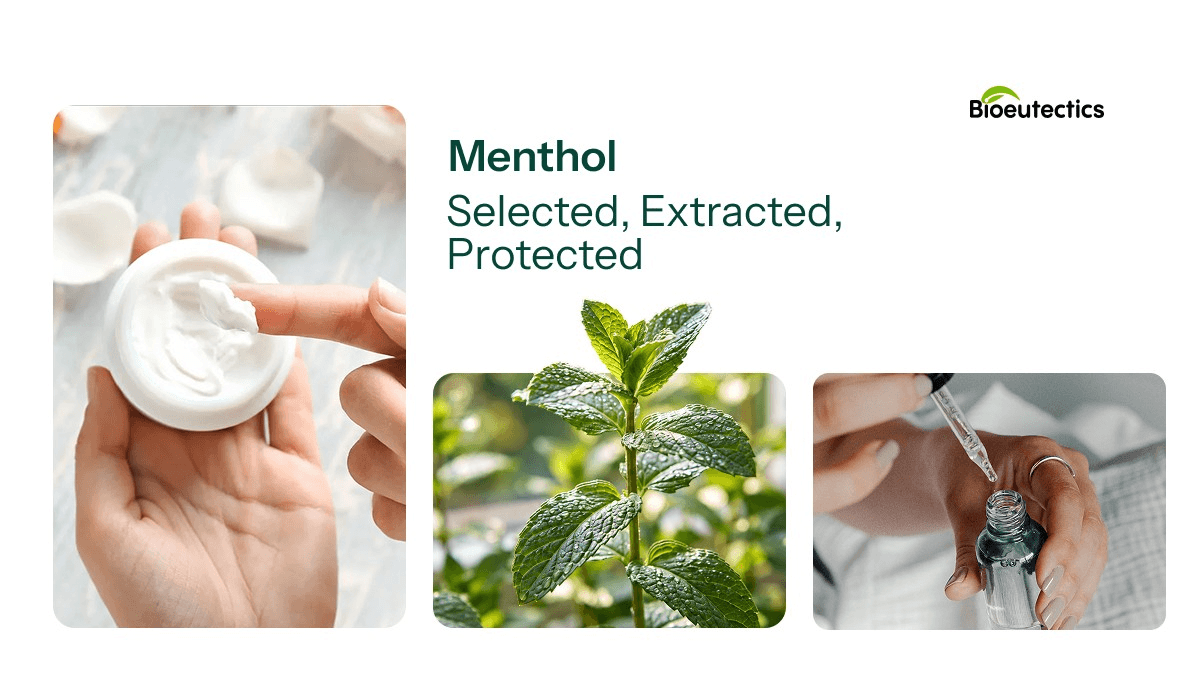
Extracting Menthol for Perfumery
Mint's characteristic "cool" sensation isn't actually a temperature change. It's the menthol in it binding to the same cold-sensing receptor on skin and mucous membranes that responds to real cold.
That same molecule is also strikingly volatile. It doesn't wait around for a solvent-removal step.
NADES can extract it selectively and keep shielding it from the oxidation and heat exposure that normally fade a natural scent over time.
Extracting Resveratrol for Skincare
Plants produce resveratrol themselves, as a defense response to injury, UV stress, and fungal attack.
Its antioxidant activity depends on the molecule staying structurally intact, which is exactly what a conventional extraction-then-stabilize process puts at risk at every handoff.
A NADES built for it would extract and protect it in the same step.

Extracting Lycopene for Food Applications
Lycopene is the carotenoid that gives tomatoes their red color, and unlike most sensitive phytochemicals, a little heat actually helps — cooking breaks down plant cell walls and converts lycopene into a form the body absorbs more easily.
Moderate heat can help release lycopene from the plant matrix and improve extraction. But push the temperature too high, extend the exposure too long, or add light and oxygen, and the balance shifts: oxidation and isomerization increase, color fades, and biological activity can decline.
Extraction faces that challenge: recovering as much lycopene as possible without tipping past the point where heat stops helping and starts destroying.
Did you enjoy this article?
If there's a specific compound giving you trouble in extraction, that's exactly the kind of case we design NADES systems around.