Rethinking performance in chemical recycling
In this article, Federico JV Gomez explores how designing the solvent environment, not pushing harsher chemistry, can change the game.

Written by
Federico Gomez, PhD
In many industrial processes, we’ve been trained to think about performance as something you “push”:
Stronger solvents. Harsher conditions. More protective infrastructure. More steps to control risk.
It can work, but it comes with a tradeoff: systemic operational cost.
And in Green Tech (especially where circularity depends on chemical processing) that tradeoff becomes the bottleneck.
Performance isn’t only about the material
A core idea behind eutectic design is that performance doesn’t belong to a single ingredient. It emerges from the environment created by interacting components, a structured liquid system designed through component selection and precise ratios.
That design logic expands the “menu” of what a solvent can be: not just a dissolver, but a tunable environment where properties can be engineered.
The shift
What I find most interesting about eutectic systems is exactly this mindset shift:
Instead of asking “what else should we add?” we ask: “What happens if we design the environment correctly from the start?”
Is moving beyond a rigid solvent ecosystem toward multimolecular systems with emergent, tunable properties, designed for safer and more adaptable industrial workflows.
Why this matters for chemical recycling
In polymer recycling, this “environment-first” approach becomes especially relevant when the solvent itself is the limiting factor, due to corrosion, strict plant requirements, handling risk, or waste constraints.
One example where we explored this idea was nylon dissolution.
Conventional approaches often rely on aggressive acids such as formic acid. They can be effective, but they also introduce corrosion, strict handling requirements, and operational complexity.
This led us to explore whether a eutectic system could interact with polymer chains in a different way: designing the solvent environment itself rather than relying on harsher chemistry.
One of the outcomes of that work is BioE-M-6-1, a eutectic system we developed for nylon dissolution.
But the interesting part isn’t the substitution itself.
The point is that it illustrates a different way of thinking about performance: not achieving it through more aggressive chemistry, but through a solvent system intentionally engineered for function.
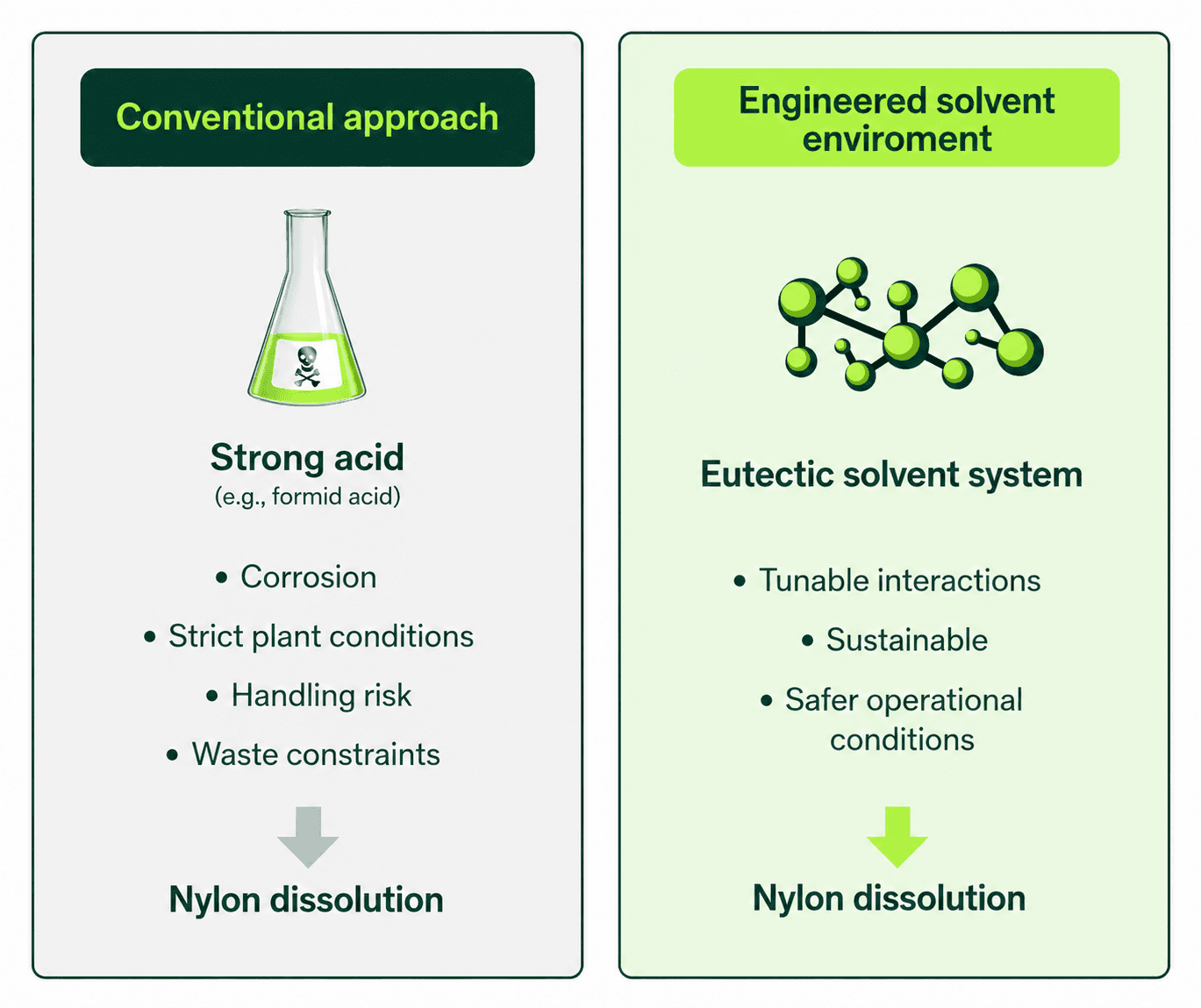
Img.1: Conceptual illustration of two approaches to nylon dissolution
The practical takeaway
If we want scalable circularity in materials (textiles, polymer streams, recovery workflows) we can’t treat solvents as a fixed constraint.
Eutectic systems offer a different lever: design the solvent environment so that performance and sustainability don’t compete.
That’s the shift. And that shift is where real innovation happens.
Did you enjoy this article?
If this perspective resonates, feel free to reach out. We’re always open to technical conversations about solvent design, process safety, and material recovery.